
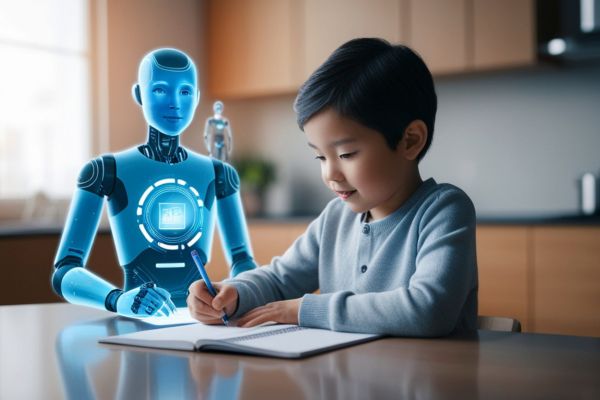
The Changing Shape of Learning
Education has always changed with the tools available to it. Chalkboards changed classrooms. Printed textbooks widened access to knowledge. Computers made research faster, and the internet opened learning far beyond the walls of schools and universities. Now, artificial intelligence is becoming the next major shift. The rise of AI in education sector is not just about new technology; it is about how students learn, how teachers teach, and how institutions understand progress.
For many people, AI still sounds futuristic, something connected with robots or advanced science labs. In reality, it has already entered everyday education in quieter ways. Students use writing assistants, language tools, study apps, and smart search platforms. Teachers use digital grading systems, plagiarism checkers, learning dashboards, and content planning tools. Schools and universities are testing AI-supported tutoring, attendance tracking, administrative automation, and personalized learning paths.
This does not mean traditional education is disappearing. A good teacher, a thoughtful lesson, and a curious student still matter more than any machine. But AI is changing the environment around them. It is offering speed, personalization, and access, while also raising serious questions about fairness, privacy, creativity, and overdependence.
Personalized Learning for Different Students
One of the biggest benefits of AI in education sector is its ability to support personalized learning. In a regular classroom, one teacher may have to guide twenty, thirty, or even more students at the same time. Each student has a different pace. Some understand a concept quickly. Others need more examples, more practice, or a completely different explanation.
AI-based learning platforms can analyze how a student responds to questions and then adjust the next lesson accordingly. A student who struggles with fractions, for example, may receive simpler exercises before moving forward. Another student who already understands the topic may be given more advanced work. This kind of flexibility is hard to achieve in a busy classroom without support.
Personalized learning can also help students feel less embarrassed. Not every child is comfortable raising a hand and saying, “I don’t understand.” With AI tools, they can practice privately and repeat lessons without feeling judged. That quiet space can make learning less stressful, especially for students who lack confidence.
Still, personalization should not become isolation. Students also need discussion, teamwork, disagreement, and real human feedback. AI can guide individual practice, but it should not replace the social side of education.
Support for Teachers, Not a Replacement
There is often fear that AI will replace teachers. That fear is understandable, but it misses the deeper point. Teaching is not only about delivering information. It involves emotional intelligence, classroom management, encouragement, ethical guidance, and human connection. AI cannot fully understand a student’s home situation, nervousness before exams, or the small signs that show when someone is losing interest.
Where AI can help is in reducing repetitive work. Teachers spend a lot of time preparing worksheets, checking assignments, organizing records, writing reports, and identifying learning gaps. AI tools can assist with lesson ideas, quiz creation, grammar checks, grading support, and performance summaries. This gives teachers more time to focus on meaningful interaction.
For example, an AI system may show that several students are making the same mistake in algebra. The teacher can then revisit that concept in class. Instead of replacing the teacher, the tool acts like an assistant that highlights patterns.
The risk comes when schools treat AI as a cheap substitute for trained educators. A classroom needs human judgment. Technology can support that judgment, but it should not be allowed to make every decision on its own.
Easier Access to Knowledge
AI can make education more accessible for students who face barriers. Language translation tools can help learners understand material in another language. Text-to-speech and speech-to-text tools can support students with visual, hearing, or writing difficulties. AI tutors can provide help outside school hours, which is useful for students who cannot afford private tuition.
This access matters. In many places, students do not have equal educational support at home. Some have parents who can help with homework; others do not. Some schools have strong libraries and experienced teachers; others struggle with limited resources. AI cannot solve every inequality, but it can offer additional learning support where traditional systems are stretched.
A student in a remote area may use an AI-powered app to practice English pronunciation. A university student may use AI to summarize complex research before reading it in detail. A child with dyslexia may use assistive tools to make reading less exhausting. These are not small improvements. For the right learner, they can be life-changing.
But access also depends on devices, internet connection, digital literacy, and cost. If AI learning tools are only available to wealthier students, the gap may become even wider.
Academic Integrity and the Question of Original Work
One of the most debated challenges of AI in education sector is academic honesty. Students can now use AI tools to generate essays, solve problems, summarize books, and create presentations. This creates a difficult question: where does assistance end and cheating begin?
The answer is not always simple. Using AI to understand a concept may be helpful. Asking AI to write an entire assignment and submitting it as personal work is dishonest. The problem is that many students are still unclear about the boundary, and many schools are still developing rules.
Teachers also face a practical challenge. Traditional homework may no longer prove what a student knows. If an essay can be generated in seconds, educators may need to rethink assessment. More oral exams, in-class writing, project discussions, personal reflections, and process-based assignments may become important.
Rather than banning AI completely, schools may need to teach responsible use. Students should learn how to use AI as a study partner, not as a replacement for thinking. They should also learn to check facts, question outputs, and develop their own voice.
Privacy, Data, and Student Safety
AI systems often depend on data. They may collect information about student performance, behavior, learning speed, mistakes, attendance, or communication patterns. This can help schools understand student needs, but it also raises privacy concerns.
Who owns the data? How long is it stored? Can it be shared with outside companies? Are students and parents clearly informed? These questions matter, especially when children are involved.
There is also the issue of bias. AI systems are trained on data, and data can reflect social inequalities. If an algorithm makes unfair assumptions about a student’s ability or behavior, it could affect opportunities. A tool that works well in one country, language, or cultural setting may not work fairly in another.
Education is a sensitive field because it shapes futures. Decisions about students should never be left entirely to automated systems. Human review, transparency, and clear policies are essential.
The Digital Divide
AI is often described as a tool for progress, but progress is not evenly distributed. Some schools have modern devices, strong internet, trained staff, and money to invest in new systems. Others lack basic facilities. In such cases, AI may benefit already privileged students first.
The digital divide is not only about having a laptop. It includes internet quality, teacher training, language access, technical support, and confidence in using technology. A school may install an AI platform, but if teachers are not trained properly, it may sit unused or be used poorly.
This is why introducing AI into education should not be treated as a quick upgrade. It requires planning, training, support, and fairness. Otherwise, the students who need the most help may receive the least benefit.
Keeping Human Skills at the Center
AI can answer questions quickly, but education is not only about quick answers. Students still need patience, curiosity, creativity, memory, discipline, and critical thinking. They need to learn how to struggle with difficult ideas. That struggle is often where real learning happens.
If students rely too much on AI, they may avoid the mental effort required to write, calculate, research, or solve problems independently. This does not mean AI should be removed. It means it should be used carefully.
A calculator did not make mathematics useless, but students still need to understand numbers. Spellcheck did not remove the need for writing skills, but students still need grammar and expression. In the same way, AI can support learning, but it should not become the mind doing all the work.
Preparing Students for an AI-Driven World
There is another reason education systems cannot ignore AI. Students are growing up in a world where AI will affect workplaces, communication, healthcare, business, media, and daily life. Schools have a responsibility to prepare them for that reality.
This means students should not only use AI tools. They should understand how they work, where they fail, and how to use them ethically. They need digital judgment. They should know that AI can produce wrong answers, biased explanations, or misleading confidence. They should also understand that human creativity, empathy, and decision-making remain valuable.
The goal is not to make every student a programmer. The goal is to make every student a thoughtful user of technology.
Conclusion: A Tool That Needs Wisdom
AI in education sector brings both promise and pressure. It can personalize learning, support teachers, improve access, and help students study in new ways. At the same time, it raises concerns about cheating, privacy, fairness, overreliance, and inequality.
The future of education should not be a choice between humans and machines. The strongest approach is likely to be a balanced one, where AI handles useful support tasks while teachers remain central to learning. Good education has always required more than information. It needs guidance, trust, patience, and care.
AI can make learning faster and more flexible, but wisdom is needed to decide how it should be used. In the end, the real question is not whether AI belongs in education. It already does. The real question is whether schools, teachers, students, and policymakers can use it in a way that protects the human heart of learning.